Tankless, if it’s right
for your house
Endless hot water and a much smaller footprint are real advantages. They are also conditional on your gas supply, your venting and how you actually use hot water — so we will tell you plainly when a tank is the better buy.
Where tankless genuinely makes sense
And a couple of cases where we will steer you back toward a tank instead.
You want the floor space back
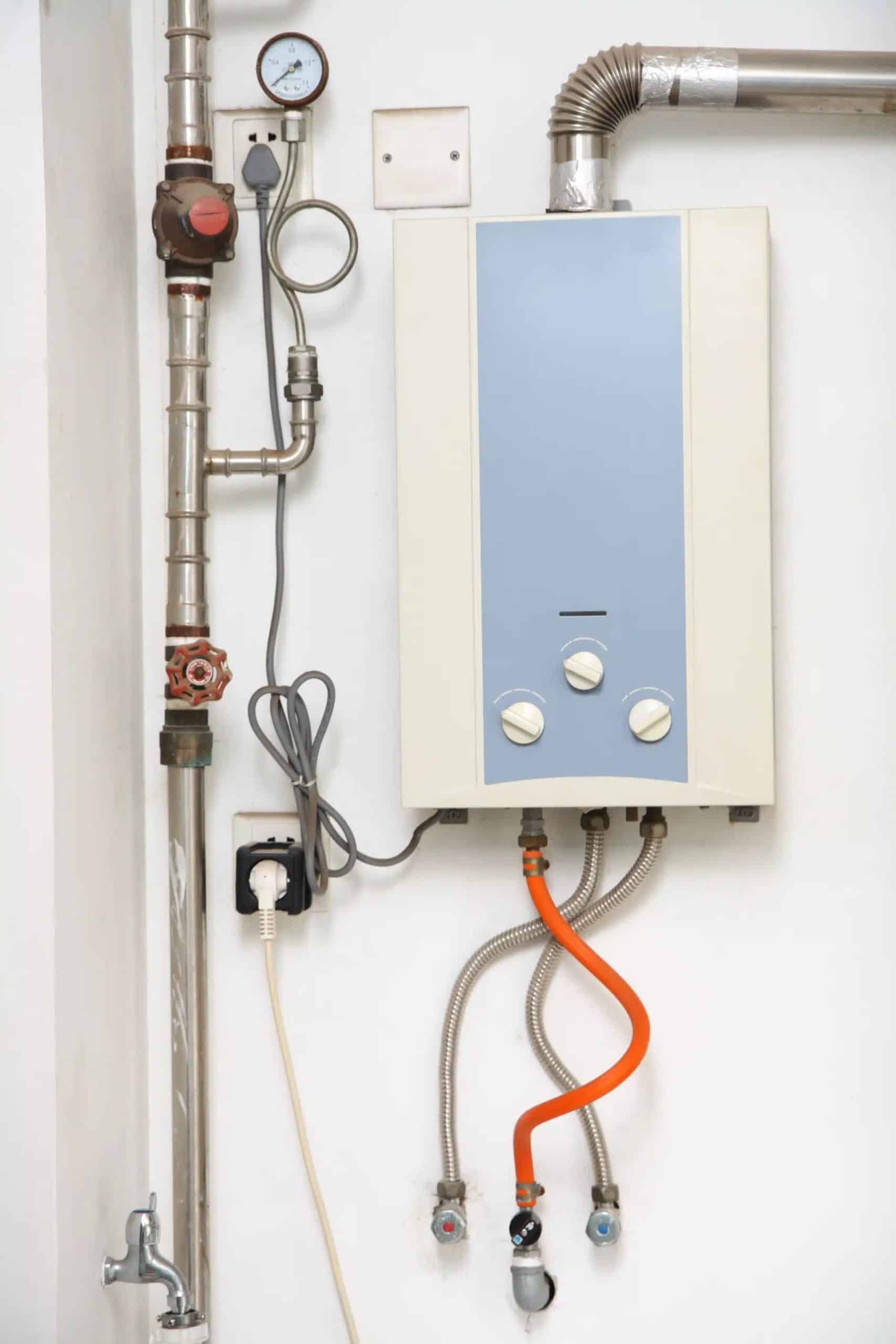
A tankless unit hangs on a wall. In a tight Hill Country garage or utility closet that is a real gain.
The tank always runs out
If back-to-back showers are the daily complaint, continuous flow solves the actual problem rather than just enlarging the tank.
You are replacing anyway
The best moment to consider it is when the old unit has failed and you are already paying to change something.
Your gas supply can carry it
Tankless units demand a lot of gas at once. Sometimes the existing line is fine; sometimes it needs upsizing, and that changes the maths.
But: very hard water raises the stakes
Scale is harder on a tankless heat exchanger than on a tank. Without softening or regular descaling, you can shorten an expensive unit’s life fast.
And: the payback is not instant
The unit and the install cost more than a tank. If you are moving in two years, we will tell you the numbers do not favour it.
How we work out whether it fits
The survey is the honest part of this job. Anyone can sell you a tankless unit; the question is whether your house can run one well.
We measure the demand
How many fixtures might run at once, and what flow rate that actually needs. This is what determines the unit, not the square footage of the house.
We check the gas and the vent
Line size, run length and available supply, plus a venting route that works. This is where most tankless projects either work or get expensive.
We talk about your water
Hard water and heat exchangers are a bad combination left alone. We cover softening and descaling before you buy, not after.
You get both options priced
Tankless and a like-for-like tank, side by side, with the honest trade-offs. Then it is your call, made with real numbers.
Tankless Water Heater
The conversation most companies skip
Tankless gets sold hard, and it deserves some of the enthusiasm — continuous hot water is genuinely better, and reclaiming the floor space matters in a lot of the homes we work in. But it is not automatically the right answer, and the places where it goes wrong are predictable.
The three that catch people out are undersized gas supply, venting that turns out to be awkward, and hard water quietly scaling an expensive heat exchanger. All three are knowable before you spend anything, which is exactly why we look at them first.
- Demand and flow-rate sizing for how the house is actually used
- Gas line capacity assessment — and upsizing where it is needed
- Venting route planned and installed to code
- Condensate handling on condensing units
- Isolation valves fitted so descaling is straightforward later
- Honest tank-versus-tankless comparison, priced both ways
- Descaling and service on units we install
Hard water is the deciding factor here
A tankless unit heats water as it passes through a narrow heat exchanger. On limestone water, that is exactly the surface scale most wants to grow on — and unlike a tank, there is no reservoir absorbing the damage. Efficiency falls first, then flow, then the unit.
None of that is a reason to avoid tankless around Boerne. It is a reason to pair it with softening, fit isolation valves at install so descaling is a routine job rather than a project, and go in knowing the maintenance is part of the deal.
Wondering if your gas line is enough?
That is usually the first question worth answering. Call and we will talk it through.
Tankless Water Heater questions
Still not sure?
Describe it on the phone and we'll tell you straight whether it needs us.
Sometimes genuinely yes, sometimes honestly no. It comes down to your gas supply, your venting, how you use hot water, how hard your water is and how long you are staying. We price both options so you can decide with real numbers rather than a sales pitch.
It will not run out, but it does have a flow-rate limit. Run enough fixtures at once and the temperature drops rather than the supply stopping. Sizing it correctly is what keeps that from being a daily annoyance.
Yes, and more attentively than a tank on our water. Periodic descaling keeps the heat exchanger clear. We fit isolation valves at installation specifically so that job is quick and cheap later.
Sometimes. Tankless units draw far more gas at once than a tank does, so the existing line is not always sufficient. We check this during the survey because it materially affects the price.
Usually, yes. It is more involved than a like-for-like tank swap because of the gas and venting work, which is why we survey it properly and quote it honestly before you commit.
Often booked alongside this
Tankless water heater installation across the Hill Country
- Alamo Heights, TX
- Alamo Ranch, TX
- Bergheim, TX
- Boerne, TX
- Bulverde, TX
- Castle Hills, TX
- Comfort, TX
- Cross Mountain, TX
- Fair Oaks Ranch, TX
- Helotes, TX
- Hill Country Village, TX
- Hollywood Park, TX
- Kendalia, TX
- Leon Valley, TX
- Nelson City, TX
- Shavano Park, TX
- Sisterdale, TX
- Spring Branch, TX
- Terrell Hills, TX
- Timberwood Park, TX
- Waring, TX
- Windcrest, TX
- All service areas
Thinking about going tankless?
Contact us Now to receive your free estimate!
Boerne & Fair Oaks Ranch, TX · Licensed Master Plumber M-38925